Translating ESBMC programs into Lean: what a second prover adds
A model checker reports one of three verdicts: safe, unsafe or unknown. ESBMC prints them as VERIFICATION SUCCESSFUL, VERIFICATION FAILED and VERIFICATION UNKNOWN. An unsafe verdict is easy to validate, because it comes with a counterexample that can be replayed against the program. A safe verdict is harder. It is the output of a parser, a symbolic execution engine, a simplifier, an SMT encoding and a solver working in sequence, and a defect in any of them can make an incorrect program look safe. Our last post ended by asking who checks the checker. ESBMC already writes verification witnesses that other teams’ validators check in SV-COMP, but a validator re-verifies the witness with its own engine, and that engine is trusted in turn.
ESBMC is the SMT-based model checker that we develop [1]. Its front ends for C, C++, Python and Solidity all produce the same intermediate language, the GOTO program. A new option, --goto2lean, prints that program as Lean 4 definitions, together with a theorem stating that no assertion fails. Lean is a proof assistant: a proof counts only once Lean’s kernel, a small checker, has accepted it. The kernel checks the finished proof independently of the automation that built it, so a bug in that automation can make a proof fail but cannot make Lean accept a false theorem. So far the new option --goto2lean handles Booleans and integers, if/else, loops, calls to non-recursive functions, and quantifiers in assertions. It rejects arrays and pointers.
The two provers help each other in both directions. When ESBMC cannot finish a proof, Lean sometimes can, and Lean’s proof shows which reasoning steps ESBMC was missing; we wrote some of those steps back into the C program and ESBMC finished. Lean, in turn, depends on a loop invariant that someone has to supply, and ESBMC rejects a wrong one within seconds, with a concrete state that shows what is missing. And if the two disagree on a program, at least one of them has a bug, which is the check our last post asked for. This work even helped us find a bug in ESBMC (fixed in #10576): an invalid simplification in unbounded-integer mode (--ir), where arithmetic on constants still wrapped at 32 bits.
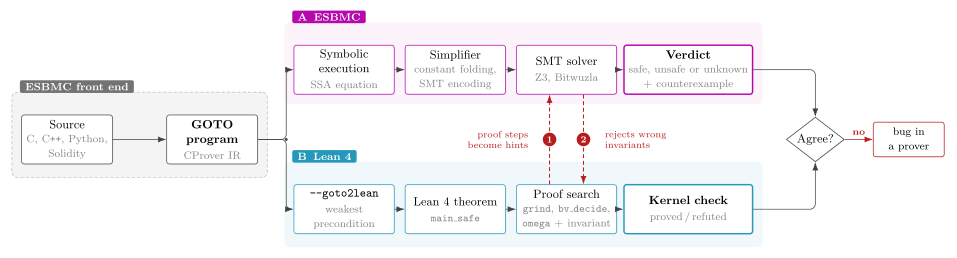
Figure 1. Two routes from the same GOTO program. Both start after the front end. The dashed arrows are the exchanges this post describes: Lean’s proof steps become hints for ESBMC (1), and ESBMC rejects wrong invariants before Lean tries them (2). When the two results disagree, one of the provers has a bug.
Note that all results below were measured locally, with ESBMC’s development version and Lean 4.35.0.
A loop that ESBMC cannot finish
Our first example is a loop that adds up the first n cubes and the first n whole numbers, then asserts Nicomachus’s theorem: the sum of the cubes equals the square of the sum, \(\sum_{i=0}^{n-1} i^3 = \left(\sum_{i=0}^{n-1} i\right)^2\). For n = 4, 0 + 1 + 8 + 27 = 36 = (0 + 1 + 2 + 3)2.
unsigned nondet_uint(void);
int main(void) {
  unsigned n = nondet_uint();
  unsigned s = 0, c = 0, i = 0;
  while (i < n) {
    s = s + i;
    c = c + i * i * i;
    i = i + 1;
  }
  __ESBMC_assert(c == s * s, "Nicomachus");
  return 0;
}
The program uses 32-bit unsigned arithmetic, so large values wrap around. Nicomachus’s theorem survives that. It is an equation built from additions and multiplications, both sides wrap in the same way, and the assertion holds for every n.
Proving something about a loop for every n needs a loop invariant: a predicate that is true before the loop and stays true after each iteration. ESBMC does not find one here by itself, and plain k-induction answers VERIFICATION UNKNOWN. So we supplied one with __ESBMC_loop_invariant: 2 * s == i * (i - 1), c == s * s and i <= n. The hard part is the middle fact. ESBMC has to show that if c equals s * s before an iteration, then c + i * i * i equals (s + i) * (s + i) after it. It passes that question to an SMT solver, which handles 32-bit arithmetic by turning every multiplication into a circuit of logic gates and searching the circuit for a counterexample. Cubing a 32-bit number gives a large circuit. Neither of the two solvers we tried, Z3 and Bitwuzla, answered within five minutes.
esbmc ucubes.c --goto2lean produces this Lean file instead:
def main_loop1 (n : BitVec 32) (s : BitVec 32) (c : BitVec 32) (i : BitVec 32)
    (post : BitVec 32 → BitVec 32 → BitVec 32 → BitVec 32 → Prop)
    (ret : BitVec 32 → Prop) : Prop :=
  (¬(i < n) →
    post n s c i) ∧
  ((i < n) →
  let s := (s + i);
  let c := (c + ((i * i) * i));
  let i := (i + (1#32));
  main_loop1 n s c i post ret)
coinductive_fixpoint

def main (post : BitVec 32 → Prop) : Prop :=
  ∀ n : BitVec 32,
  let s := (0#32);
  let c := (0#32);
  let i := (0#32);
  main_loop1 n s c i (fun (n : BitVec 32) (s : BitVec 32) (c : BitVec 32) (i : BitVec 32) =>
    -- Nicomachus
    (c = (s * s)) ∧ (
    post (0#32))) post

theorem main_safe : Prog.main (fun _ => True) := by
  -- Not closed automatically: each loop needs an invariant (apply Prog.<loop>.coinduct).
  sorry
Listing 1. The Lean that --goto2lean generates for the loop, with the namespace and one renaming line removed. sorry is Lean’s placeholder for a missing proof.
Listing 1 is the inductive version of the program. The while loop is gone; in its place is main_loop1, a definition that refers to itself. Read it as a statement about one visit to the loop head with the current values of n, s, c and i. If i < n is false, the loop exits and the final check c = s * s must hold. Otherwise the body runs once, giving new values of s, c and i, and the same statement must hold again for those values, which is the self-reference. main makes the first visit, with s, c and i at zero and n arbitrary (the ∀). The rest of the file follows one pattern: a nondeterministic value becomes ∀, an __ESBMC_assume becomes →, and an assertion becomes ∧. One keyword is new: coinductive_fixpoint allows the loop to run forever. A run that never exits never reaches the assertion, so the theorem only constrains runs that terminate.
From that definition Lean derives a proof rule, Prog.main_loop1.coinduct. To use it, you give a property of the loop variables. You then show that it holds at the first visit, and that whenever it holds at the loop head, the statement above holds with the property in place of the self-reference. That property is the loop invariant, and the rule is the loop-invariant rule of Hoare logic. Lean derives it from the definition, so the rule itself does not have to be trusted. Replacing sorry with the invariant we gave ESBMC, plus one line of automation, completes the proof:
theorem main_safe : Prog.main (fun _ => True) := by
  simp only [Prog.main]
  intro n
  apply Prog.main_loop1.coinduct n _ _
    (fun s c i => 2#32 * s = i * (i - 1#32) ∧ c = s * s ∧ i ≤ n)
  all_goals grind
Listing 2. The proof that replaces sorry. Lean checks it in 1.7 seconds.
The apply ... coinduct line leaves three goals: the invariant holds before the loop, it survives one iteration, and on exit it implies the assertion. all_goals grind sends each of them to grind, Lean’s general-purpose automation, the hammer you try before writing a proof by hand. So the only part a person writes is the invariant, the same one we gave ESBMC. Our first version of the proof handled each goal by hand, using grind for the step and bv_omega (Lean’s tactic for linear bit-vector arithmetic) for the bounds. Lean’s try? command, which searches for a tactic that closes the current goal, suggested grind for the goals we tried it on, and a single all_goals grind then closed all three. The translator could emit these lines whenever the program carries an __ESBMC_loop_invariant; it does not do so yet.
Part of what grind does is algebra. On the step, it expands (s + i) * (s + i), uses 2 * s = i * (i - 1) to rewrite the result, and finds that both sides are the same polynomial, as you would on paper. It never builds a circuit, so the cube costs it no more than a sum. The gain comes from the algebra, not from Lean as such. When we replaced grind with bv_decide, the Lean tactic that does build a circuit and call a SAT solver, it timed out too.
What ESBMC can learn from Lean’s proof
Lean finished the proof, but ESBMC is the tool people run on their code, so we asked what Lean’s proof could teach it. The proof does three things that ESBMC’s single query to the solver does not. Lean proves the start, the step and the exit as separate goals. At the exit it has to conclude i = n from i ≤ n and ¬(i < n), which our hand-written version did in one line (have : i = n := by bv_omega; subst this). And on the step, grind uses the invariant’s equations as rewrite rules. We tested each move by writing it back into the C program.
Hints and separate goals. We copied grind’s algebra into the loop body as four __ESBMC_assume statements: the expansion of (s + i) * (s + i), the regrouping of 2 * s * i, the substitution of i * (i - 1) for 2 * s, and the expansion of i * (i - 1) * i + i * i. Each holds for every 32-bit value. ESBMC proves the two expansions in under a second each, as separate programs. The regrouping needs no proof: C’s * associates to the left, so 2 * s * i already means (2 * s) * i, and ESBMC’s simplifier removes this hint before the solver sees it. The substitution is congruence: equal values multiplied by the same i stay equal. Over plain variables ESBMC proves it in under a second, but with the products written in, neither Z3 nor Bitwuzla proves it within 300 seconds, while Lean closes it with rw [h]. We then ran ESBMC with --multi-property, which sends each claim to the solver on its own, the way Lean splits its proof into goals. Z3 proves the 32-bit program in 6.0 seconds:
unsigned nondet_uint(void);
int main(void) {
  unsigned n = nondet_uint();
  unsigned s = 0, c = 0, i = 0;
  __ESBMC_loop_invariant(2 * s == i * (i - 1) && c == s * s && i <= n);
  while (i < n) {
    __ESBMC_assume((s + i) * (s + i) == s * s + 2 * s * i + i * i);
    __ESBMC_assume(2 * s * i == (2 * s) * i);
    __ESBMC_assume(2 * s != i * (i - 1) || (2 * s) * i == (i * (i - 1)) * i);
    __ESBMC_assume(i * (i - 1) * i + i * i == i * i * i);
    s = s + i;
    c = c + i * i * i;
    i = i + 1;
  }
  __ESBMC_assert(c == s * s, "Nicomachus");
  return 0;
}
Listing 3. The 32-bit Nicomachus program with grind’s steps written in. esbmc --loop-invariant-check --multi-property --z3 reports VERIFICATION SUCCESSFUL in 6.0 seconds.
Each half fails without the other, for different reasons. Without the hints, the step times out even on its own. Our reading is that the solver would have to discover intermediate terms such as (2 * s) * i inside the multiplier circuits. The hints name those terms and say how they relate, so the step becomes a chain of equalities: (s + i)2 = s2 + (2s)·i + i2 = s2 + i(i − 1)·i + i2 = s2 + i3 = c + i3. Given the hints, Z3 proves the step in 4.7 seconds.
Without --multi-property, ESBMC puts all claims into one query, and there the hints looked useless: neither solver answered in 300 seconds. We traced that to the exit claim, which checks that the invariant implies the assertion once the loop ends. Checked by itself, the exit claim follows directly from the invariant, and Z3 proves it in under a millisecond. The start and the step, checked together in one query without the exit claim, prove in 2.6 seconds. Put all three in one query and Z3 times out. We do not yet know why the combination is so much harder than its parts. Bitwuzla timed out in every configuration we tried, so these results hold for Z3 only.
The 32-bit Gauss loop, which keeps only s and asserts 2 * s == n * (n - 1), broke where we least expected it. With its invariant, both solvers stall on the exit claim: from 2 * s == i * (i - 1), i <= n and !(i < n), conclude 2 * s == n * (n - 1). Written with i == n in place of the two inequalities, the same claim takes 0.46 seconds in both solvers. The solvers never derive the equality and substitute it. They compare two 32-bit multipliers bit by bit, and Lean’s proof avoids that with one line. With __ESBMC_assert(i == n, ...) after the loop and --multi-property, Z3 proves the whole Gauss program in 0.57 seconds. Either change alone leaves it without a verdict.
Two of these moves could become ESBMC heuristics. The exit equality is cheap and local: when an invariant contains i <= n and the loop exits on !(i < n), ESBMC can add i == n and substitute it before checking what follows. Solving the claims of an invariant separately is already an option and could be the default under --loop-invariant-check. The rewriting is harder. As a claim of its own, the identity behind grind’s step, (s + i)2 − (c + i3) = (s2 − c) + i·(2s − i(i − 1)), proves in 0.45 seconds in both solvers, but adding it as a fact to the step does not help. Bitwuzla’s built-in abstraction of multiplication, which by default starts at 33 bits, did not help either when we lowered it to 32 bits on ESBMC’s formulas. What the solvers lack is the use of an equation between products as a rewrite rule. That needs a pass in ESBMC that normalizes polynomials and substitutes the invariant’s equations before the formula reaches the solver. We have not built it; Listing 3 does its job by hand.
What Lean can get from ESBMC
Lean’s proof stands or falls with the invariant, and whoever proposes invariants, a person or a language model, gets some of them wrong. Telling why an invariant is wrong is what ESBMC does well and Lean does not.
So we put ESBMC in front of Lean, in a short shell script. It takes a list of candidate invariants, each written once in C and once in Lean. For each candidate it runs esbmc --loop-invariant-check --multi-property with a 30-second budget. If ESBMC refutes the candidate, the script prints the failing claim and ESBMC’s state. When ESBMC has no verdict, the script writes the proof of Listing 2 with the candidate in place of the invariant and runs Lean on it. We gave it three wrong candidates for the 32-bit Nicomachus loop, and also ran Lean on each of them directly:
| Candidate invariant | ESBMC | Lean, all_goals grind
|
|---|---|---|
c == s * s && i <= n |
rejected in 0.45 s: the step fails at a given state | fails in 1.9 s, 1,162 lines of diagnostics |
2 * s == i * (i + 1) && c == s * s && i <= n |
rejected in 0.42 s: the step fails at a given state | fails in 1.8 s, 514 lines |
4 * c == i * i * (i - 1) * (i - 1) && 2 * s == i * (i - 1) && i <= n |
rejected in 10.8 s: too weak for the assertion, at a given state | fails in 1.9 s, 923 lines |
Each rejection comes with a reason. For the first candidate, ESBMC’s state has i = 255 and s = 67372036, so 2 * s is 134744072 while i * (i - 1) is 64770: nothing in the invariant ties s to i, and one more iteration breaks c == s * s. The third candidate is the closed form of the sum of cubes, which an engineer or a model could well propose, and it is true over the integers. Over 32-bit words, 4 * c == (2 * s) * (2 * s) fixes c only up to multiples of 230. ESBMC’s state on exit, s = 229 and c = 230, satisfies the invariant, while s * s wraps to 0 and the assertion fails. ESBMC reports this as UNKNOWN, invariant too weak, because the state need not be reachable in the real program; for screening, it rules the candidate out all the same.
Lean fails on all three as well, and about as fast, but a failed grind is not a rejection. It can mean that the invariant is wrong or only that grind needs help, and its diagnostics do not say which. They include an assignment for the linear part of the problem, but there each product is a free unknown: for the third candidate, grind sets s to 2147483648 and, independently, the square of s to 1. That is not a state of the program.
A rejection from ESBMC does not have to be taken on trust either. Lean checks ESBMC’s state for the third candidate by evaluation, with decide, in 1.5 seconds: the invariant holds, the loop has exited, and c ≠ s * s.
What comes next
- Heuristics learned from Lean’s proofs. The exit equality and per-claim solving are small changes to ESBMC, and we plan to try them first. The larger one is the rewriting pass that Listing 3 does by hand: normalize polynomials and substitute the invariant’s equations before the formula reaches the solver.
-
Proof scripts from the translator. When the program carries an
__ESBMC_loop_invariant,--goto2leancould emit theapplyandall_goals grindlines of Listing 2 instead ofsorry, so that a proof like this one needs no Lean from the user. - Invariants from models, screened by ESBMC. The screening script is the first piece. Next we connect it to a language model that proposes the candidates [2], so that ESBMC discards the wrong ones and Lean proves the rest.
-
Prove the translator. Neither route checks
--goto2leanitself. Rafael’s PhD thesis [3] gives GOTO a formal semantics, partly mechanized in Isabelle; carried over to Lean, it would let us prove the translator correct and state when an ESBMC pass preserves a program’s meaning.
Join us
We are looking for PhD students, postdocs and collaborators interested in these problems: formal methods, program analysis and interactive theorem proving. ESBMC is open source, and the translator, its regression tests and its documentation are in ESBMC master. If this interests you, email Lucas Cordeiro with a short note on what you would like to work on, or talk to the group first on our public Zulip chat.
References
- [1] P. V. Dantas, L. C. Cordeiro, and W. S. S. Júnior, “ESBMC: A Survey of Its Evolution, Integration, and Future Directions in Formal Software Verification,” CoRR, vol. abs/2605.26169, 2026, doi: 10.48550/arXiv.2605.26169. DOI
- [2] M. A. A. Pirzada, G. Reger, A. Bhayat, and L. C. Cordeiro, “LLM-Generated Invariants for Bounded Model Checking Without Loop Unrolling,” in Proceedings of the 39th IEEE/ACM International Conference on Automated Software Engineering, ASE 2024, Sacramento, CA, USA, October 27 - November 1, 2024, V. Filkov, B. Ray, and M. Zhou, Eds., ACM, 2024, pp. 1395–1407. doi: 10.1145/3691620.3695512. DOI
- [3] R. S. Menezes, “A formal semantics for GOTO in the CProver ecosystem,” PhD thesis, University of Manchester, 2025. Available at: https://research.manchester.ac.uk/en/studentTheses/a-formal-semantics-for-goto-in-the-cprover-ecosystem/ Link